7 Recession-Proof Investments That Actually Work in 2026
Discover recession-proof investments backed by data. Learn which assets protect your portfolio when the economy slows in 2026.

Recession-proof investments are no longer a “nice to have” — they are becoming a necessity. Moody’s Analytics recently raised its U.S. recession probability to 49%, while JPMorgan puts the odds at roughly 35%. Between escalating tariff wars, volatile oil prices, and a Federal Reserve caught between inflation and growth, the economic outlook for the rest of 2026 is anything but certain.
But here is what most recession guides get wrong: they tell you to panic-sell into cash. The data tells a different story. During the last five U.S. recessions, certain asset classes did not just survive — they outperformed. The key is knowing which ones, and positioning your portfolio before the downturn hits.
What’s Happening: Why Recession Risk Is Rising in 2026
The recession signals are stacking up in ways that are hard to ignore. The U.S. economy is facing a rare combination of pressures that have historically preceded downturns.
Trade policy uncertainty is the biggest wildcard. The latest round of tariffs has disrupted supply chains across manufacturing and agriculture. The Peterson Institute for International Economics estimates that current tariff levels could shave 0.5-1.0% off U.S. GDP growth over the next 12 months.
Consumer spending is weakening. Retail sales growth slowed to 1.2% year-over-year in early 2026, down from 3.8% a year earlier. Credit card delinquency rates have climbed to their highest level since 2011, according to Federal Reserve data.
The yield curve inverted again. While inversions do not predict exact timing, every U.S. recession since 1970 was preceded by a yield curve inversion. The 2-year/10-year spread turned negative in late 2025 and has stayed there.
Does this guarantee a recession? No. But it means the probability is high enough that every investor should have a defensive plan. The good news is you do not need to time the market perfectly — you just need to own the right assets before the downturn arrives.
The 7 Best Recession-Proof Investments for 2026
Not all “safe” investments are created equal. Some protect your capital but deliver zero growth. Others maintain strong returns even during economic contractions. Here is the data on what actually works.

1. Consumer Staples Stocks
People still need toothpaste, food, and laundry detergent during a recession. That is why consumer staples have been the most reliable recession-proof sector for over 50 years.
Historical performance: During the 2008 financial crisis, the S&P 500 fell 55% from peak to trough. The Consumer Staples Select Sector (XLP) dropped only 29% — nearly half the market’s decline. In the 2020 COVID crash, staples recovered to pre-crash levels weeks faster than the broader market.
Key companies and why they work:
| Company | Consecutive Dividend Increases | Why It’s Recession-Proof |
|---|---|---|
| Procter & Gamble (PG) | 69 years | Essential household products, pricing power |
| Coca-Cola (KO) | 64 years | Global brand, low-cost product, margin strength |
| Colgate-Palmolive (CL) | 62 years | Oral care monopoly, emerging market growth |
| Costco (COST) | 21 years | 93%+ membership renewal rate, value positioning |
These companies do not just survive recessions — they tend to gain market share as consumers trade down from premium brands to trusted value brands.
2. Healthcare Stocks
Medical care is non-discretionary. People do not cancel surgeries or stop taking medications because the economy is slowing down. This makes healthcare one of the most consistent defensive sectors.
Historical performance: Healthcare stocks outperformed the S&P 500 in four of the last five recessions. During the 2001 dot-com bust, while the Nasdaq lost 78%, the Healthcare Select Sector (XLV) was essentially flat.
Strongest recession-proof picks in the sector:
- Johnson & Johnson (JNJ): Diversified across pharmaceuticals, medical devices, and consumer health. Revenue grew during the 2008 recession.
- UnitedHealth Group (UNH): The largest U.S. health insurer. Demand for health insurance does not disappear in downturns — if anything, government programs expand enrollment.
3. Utility Stocks
Electricity, water, and natural gas are bills people pay regardless of economic conditions. Utility companies operate as regulated monopolies with predictable cash flows and high dividend yields.
Historical performance: Utilities outperformed the S&P 500 by an average of 15 percentage points during the 2001 and 2008 recessions, according to S&P Global data.
Why NextEra Energy (NEE) stands out: It is the world’s largest generator of wind and solar energy. The clean energy transition provides a secular growth tailwind on top of the traditional defensive characteristics of utility stocks. Its dividend has grown at an average annual rate of 10% over the past decade.
4. U.S. Treasury Bonds
When fear rises, money flows into U.S. Treasuries. This is the most reliable pattern in financial markets. Treasury bonds gained value in every single U.S. recession since 1970.
Why Treasuries work in recessions:
- The Fed typically cuts interest rates during recessions, which pushes bond prices up
- Treasuries carry zero default risk (backed by the U.S. government)
- They provide steady income regardless of stock market performance
Current opportunity: With the 10-year Treasury yield sitting near 4.2% in early 2026, bonds are offering their most attractive income in over a decade. If the Fed cuts rates in response to a slowdown, bondholders would also benefit from price appreciation.
How to invest: Individual Treasury bonds via TreasuryDirect.gov, or through bond ETFs like iShares 7-10 Year Treasury Bond ETF (IEF) or Vanguard Total Bond Market ETF (BND).
5. Gold and Precious Metals
Gold is the classic crisis hedge, and the data backs it up. During the 2008 financial crisis, gold rose 25% while the S&P 500 fell 55%. In 2020, gold hit all-time highs as the pandemic rattled markets.
Why gold works in 2026 specifically:
- Central bank buying remains near record levels. The World Gold Council reports that central banks purchased over 1,000 tonnes of gold in both 2023 and 2024
- Geopolitical uncertainty (tariff wars, Middle East tensions) drives safe-haven demand
- Real interest rates may decline if the Fed cuts rates, which historically boosts gold prices
How to invest: Physical gold is impractical for most investors. Instead, consider SPDR Gold Shares (GLD) or iShares Gold Trust (IAU) for direct gold exposure. For mining stocks, the VanEck Gold Miners ETF (GDX) offers leveraged exposure to gold price movements.
6. Dividend-Focused ETFs
If picking individual recession-proof stocks feels overwhelming, dividend ETFs provide instant diversification across the most defensive sectors.
Top recession-proof dividend ETFs:
| ETF | Yield | Focus | Expense Ratio |
|---|---|---|---|
| Vanguard Dividend Appreciation (VIG) | ~1.8% | Companies with 10+ years of dividend growth | 0.06% |
| Schwab U.S. Dividend Equity (SCHD) | ~3.4% | High-quality dividend payers | 0.06% |
| iShares Select Dividend (DVY) | ~3.8% | High-yield dividend stocks | 0.38% |
Why SCHD is particularly well-suited for recessions: It screens for companies with strong free cash flow, low debt, and consistent dividend history — exactly the qualities that help businesses survive downturns. During the 2022 bear market, SCHD outperformed the S&P 500 by over 10 percentage points.
7. Cash and High-Yield Savings
This is not exciting advice, but it may be the most important. Having 6-12 months of living expenses in cash is your first line of defense against a recession.
Why cash matters beyond the obvious:
- It prevents you from selling investments at the worst possible time
- It gives you buying power when markets crash — the best investment opportunities arise during recessions
- High-yield savings accounts currently pay 4.5-5.0% APY, meaning your cash buffer actually earns meaningful returns
Retirement expert Maurie Backman at The Motley Fool recommends retirees hold up to two years of living expenses in cash to avoid being forced to sell assets during a downturn. This is sound advice for anyone within 10 years of retirement.
Building a Recession-Proof Investment Portfolio
Owning the right assets matters, but how you combine them determines whether your portfolio actually survives a downturn. Here is a framework for building a recession-proof allocation.
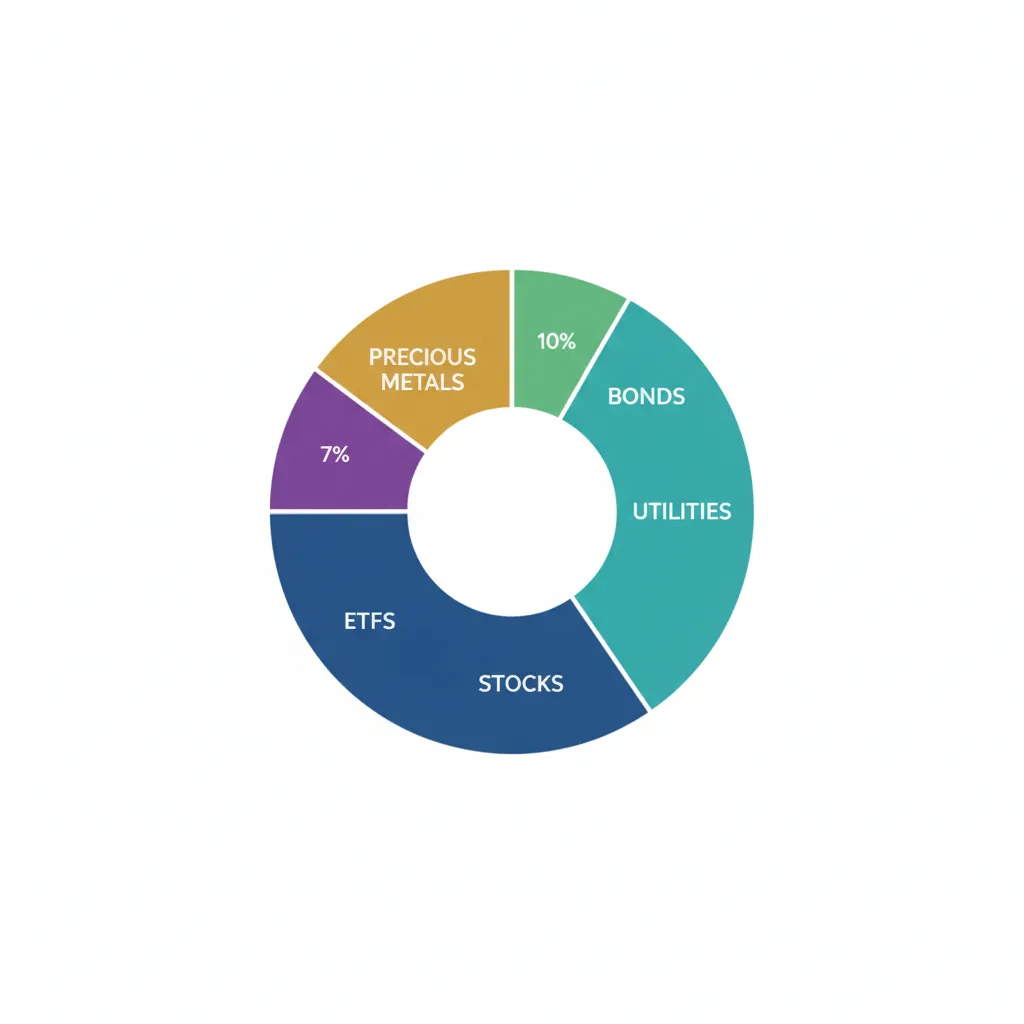
Sample Defensive Portfolio Allocation
| Asset Class | Allocation | Purpose |
|---|---|---|
| Consumer Staples & Healthcare | 30% | Stable earnings, dividend income |
| U.S. Treasury Bonds | 25% | Capital preservation, rate cut upside |
| Dividend ETFs | 20% | Diversified income, lower volatility |
| Gold & Precious Metals | 10% | Crisis hedge, inflation protection |
| Utilities | 10% | Regulated income, defensive growth |
| Cash / High-Yield Savings | 5% | Liquidity, buying power |
Key Principles
You do not need to go 100% defensive. If you are under 40 with a long investment horizon, shifting even 20-30% of your portfolio toward defensive assets provides meaningful protection while keeping growth exposure.
Rebalance, do not panic-sell. The worst mistake investors make is selling everything after the market has already dropped. Rebalancing means selling winners and buying losers systematically — which is exactly what the data says you should do.
Dollar-cost average into defensive positions. Do not try to time the recession perfectly. Spread your defensive purchases over 3-6 months. If the recession does not materialize, you still own quality assets that pay dividends.
What to Avoid During a Recession
Knowing what not to buy is just as important as knowing what to buy.
- High-growth tech stocks with no profits: Companies burning cash rely on investor optimism. In a recession, that optimism evaporates first.
- Highly leveraged companies: Debt is manageable when times are good. When revenue drops and credit tightens, leverage kills.
- Cyclical sectors (luxury goods, travel, construction): These sectors see the sharpest revenue declines during economic contractions.
- Cryptocurrency as a “safe haven”: Despite the narrative, Bitcoin fell 65% during the 2022 bear market. Crypto correlates with risk appetite, not with safety.
Frequently Asked Questions
What Is the Safest Investment in a Recession?
U.S. Treasury bonds are widely considered the safest investment during a recession. They carry zero default risk, typically appreciate in value as the Fed cuts interest rates, and provide predictable income. For maximum safety, short-term Treasuries (1-3 year maturities) offer the least price volatility while still paying competitive yields — currently around 4.0-4.5%.
How Should You Prepare for a Recession in 2026?
Start with three steps: (1) build a cash buffer of 6-12 months of living expenses in a high-yield savings account, (2) shift a portion of your portfolio toward defensive assets like consumer staples, healthcare, utilities, and bonds, and (3) reduce any high-interest debt, especially variable-rate loans that could become more expensive. The time to prepare is before the recession is officially declared — by then, defensive assets are already priced up.
What Would Be the Best Investment for 2026?
There is no single “best” investment, but a diversified mix of recession-proof assets is likely the strongest approach for 2026. Consumer staples stocks with long dividend track records (like Procter & Gamble and Coca-Cola) offer stability and income. U.S. Treasury bonds provide a hedge against equity declines. Gold offers protection against geopolitical uncertainty. The key is not picking one winner — it is building a portfolio that performs reasonably well across multiple scenarios.
Are Dividend Stocks Safe During a Recession?
Not all dividend stocks are safe — only those with strong balance sheets, low payout ratios, and essential products or services. Look for companies classified as “Dividend Aristocrats” (25+ consecutive years of dividend increases) or “Dividend Kings” (50+ years). These companies have proven they can maintain and grow dividends through multiple recessions. Avoid high-yield stocks with unsustainable payout ratios, as those dividends are often the first to be cut during downturns.
Should You Hold Cash or Invest Before a Recession?
Both. Hold enough cash to cover 6-12 months of expenses and avoid forced selling during a downturn. But do not go all-cash — inflation erodes purchasing power, and you will likely miss the eventual recovery rally. The ideal approach is to maintain your cash buffer while gradually shifting investment allocations toward defensive positions. Remember that some of the best buying opportunities in history occurred during recessions, so having both cash and investments gives you maximum flexibility.
Bottom Line
Recessions are not a matter of if — they are a matter of when. With recession probabilities at their highest levels since 2020, the time to position your portfolio defensively is now, not after the downturn begins. Focus on assets with proven track records: consumer staples, healthcare, utilities, Treasury bonds, gold, and quality dividend payers. Keep a solid cash buffer. And resist the urge to panic when volatility spikes — that is exactly when defensive portfolios earn their keep.
This article is for informational purposes only and does not constitute investment advice. Always do your own research before making financial decisions.